NADDC Board Inspects Auto Plants, Manufacturers Seek Stronger Policy Support
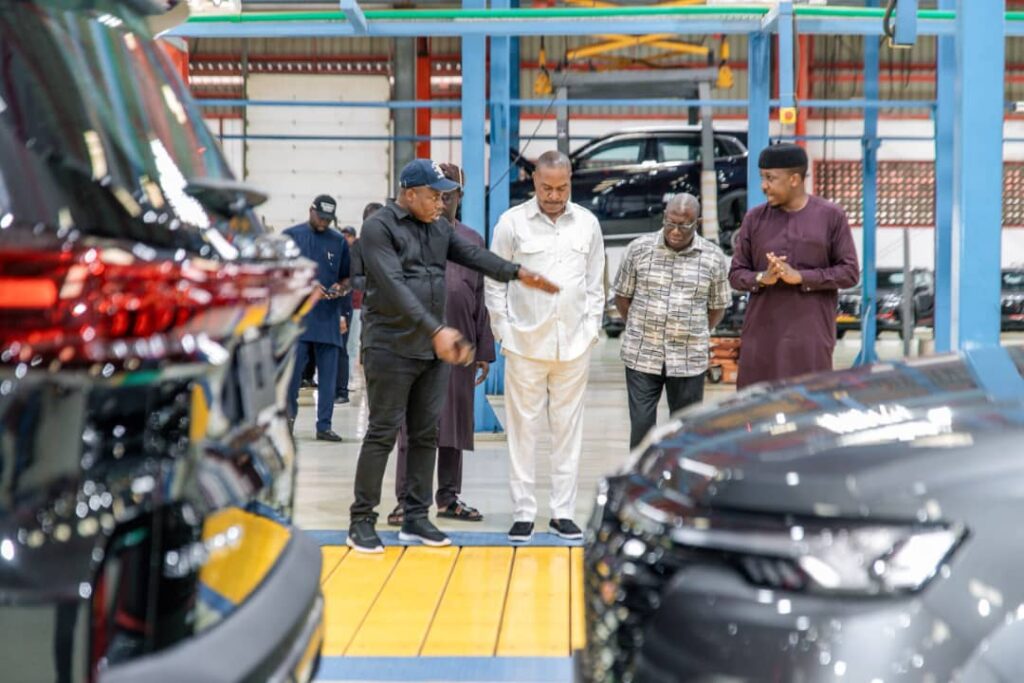
- L-R: Director General of the National Automotive Design and Development Council (NADDC), Otunba Oluwemimo Joseph Osanipin; Chairman of NADDC Board, Chief Emma Eneukwu; Chairman, Nigerian Automotive Manufacturers Association (NAMA), Mr Bawo Omagbitse and National Operations Manager, Mikano Motors, Syam Abdulkadir, during an inspection tour of Mikano Motors assembly plant in Warewa, along Lagos-Ibadan Expressway, on Tuesday, September 16, 2026
The Director-General/CEO of the National Automotive Design and Development Council (NADDC), Oluwemimo Joseph Osanipin, has led members of the council’s Governing Board on an oversight inspection of major automobile assembly plants in Lagos and Ogun states, as manufacturers called for stronger government policies and incentives to deepen local vehicle production.
The inspection covered Mikano Motors assembly plant in Ogun State, CIG Motors assembly plant in Ogba, Lagos, and Lanre Shittu Motors.
Speaking during the exercise, Chairman of the NADDC Governing Board, Chief Emma Eneukwu, said the visit provided the board with firsthand knowledge of the level of local technical capacity available in Nigeria’s automotive sector.
Eneukwu noted that Nigerians constitute a significant part of the workforce in the plants visited, demonstrating that the country has the human capacity required to produce vehicles locally if the right policies and support are provided.
He urged the government to strengthen support for local manufacturers and promote the use of locally produced components, warning that cheaper imported vehicles and components could undermine domestic assembly operations if appropriate protection and incentives were not provided.
According to him, the proposed automotive industry legislation should address the challenges confronting local manufacturers, provide appropriate incentives and create an environment capable of encouraging more investment in vehicle manufacturing.
He also expressed concern over the influx of used vehicles, saying the government should establish appropriate standards concerning the age and quality of imported used vehicles to protect local manufacturers and consumers.
Osanipin said the essence of the inspection was to enable the board and management of NADDC to understand the realities of automobile manufacturing by interacting directly with manufacturers and obtaining firsthand information on their challenges.
He said the visit also provided an opportunity for the board to assess the production capacity available in the country and determine how the council could provide solutions to challenges facing manufacturers.
The NADDC boss highlighted local component manufacturing as one of the areas requiring attention, citing locally produced brake pads which, according to him, had demonstrated significantly better durability but were forced out of the market because imported alternatives were cheaper.
He said the council was working on an automotive industry bill that would take such challenges into consideration and create a framework capable of strengthening local production and backward integration.
At Mikano Motors, the National Operations Manager, Syam Abdulkadir, said the company currently had the capacity to meet consumer demand, adding that production was carried out daily.
Abdulkadir said the company had more than 10,000 vehicles in stock apart from its ongoing assembly operations, while its production capacity stood at about 15,000 to 20,000 vehicles.
He said increased patronage of locally assembled vehicles would encourage manufacturers to invest more in Nigeria, noting that Mikano, which has operated in the country for more than 30 years, was already planning to move from Semi Knocked Down (SKD) assembly to Completely Knocked Down (CKD) production.
He also disclosed that Mikano previously produced brake pads locally but discontinued production because imported alternatives were cheaper, despite differences in quality and durability.
Abdulkadir said the company was working with Original Equipment Manufacturers (OEMs) to increase local content and would continue to explore opportunities to produce more vehicle components locally.
At CIG Motors, Brigadier General Chukwuemeka Udaya (Rtd.), Special Adviser to the Chairman on Government Relations, described the oversight visit as an opportunity for the NADDC board to verify the company’s activities and understand its challenges.
He said CIG Motors regularly submits reports to NADDC, adding that the physical inspection allowed the council to assess what the company was doing correctly, identify areas requiring improvement and better understand its operational challenges.
Udaya described the visit as largely successful, saying CIG Motors remained focused on producing affordable vehicles for the Nigerian market.
“We are a very focused and visionary organisation. We have one of the brilliant products in this country. The cost of our vehicles is about the most affordable in Nigeria,” he said.
According to him, in some cases, the price of a tokunbo vehicle could be sufficient to purchase a brand-new vehicle from CIG Motors, making locally assembled vehicles a viable option for Nigerian consumers.
Udaya also highlighted the company’s investment in young Nigerians, saying most of the workers at the facility were young people, many of them below 27 years.
He said CIG Motors had established partnerships with universities across Southern Nigeria, including Yaba College of Technology, through which students undertake industrial attachments at the company.
Beyond industrial attachments, he said the company had sponsored young Nigerians from universities and YABATECH for 18-month postgraduate training in China, with the objective of transferring engineering and manufacturing knowledge to Nigeria.
According to him, the training would contribute to backward integration by enabling the beneficiaries to return with technical knowledge and experience that could be applied to vehicle manufacturing in Nigeria.
Udaya further disclosed that CIG Motors was partnering with the Federal Ministry of Humanitarian Affairs and Poverty Alleviation to train young Nigerians in automobile maintenance.
He said the company had the capacity to train more than 25,000 young Nigerians in automobile maintenance over a period of two to three years, describing the programme as a source of pride for CIG Motors.
Also speaking, Managing Director of Lanre Shittu Motors, Taiwo Shittu, said the company was pleased to receive the NADDC board and use the inspection to demonstrate its production activities and explain areas where government support was required.
Shittu said the company already sourced some components locally, including seals, lubricants from Kano and Ogun states, and rubber components.
He called for policies that would guarantee investments and provide stronger incentives to attract more investors and international partners into Nigeria’s automotive industry.
According to him, potential partners were waiting for a policy environment that would provide confidence and predictability for long-term investment.
Shittu said access to foreign exchange had also improved compared with previous periods, adding that the company had one expatriate and 326 Nigerians in its workforce.
He said the development demonstrated that Nigerians had the capacity to participate effectively in vehicle manufacturing when given the opportunity, training and necessary technical know-how.
The Lanre Shittu Motors boss also disclosed that the company was already working with partners on electric vehicles and other new-energy technologies, including CNG and EVs.
He said government patronage of locally produced vehicles was improving but could be strengthened further through supportive policies.
Shittu added that the company had vehicle financing arrangements with Access Bank, Stanbic Bank, Wema Bank and CreditCorp to make vehicle acquisition easier for customers.
The inspection is part of efforts by NADDC to deepen engagement with automotive manufacturers, understand the challenges affecting local assembly and strengthen the country’s transition towards increased local content and vehicle manufacturing.
About The Author