Senate Passes Bill to Alter Constitution in Favour of State Police
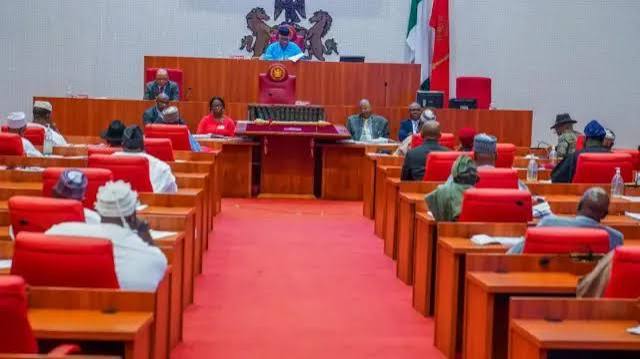
The Senate on Wednesday okayed the establishment of State Police by passing a bill for an Act to Alter the Constitution of the Federal Republic of Nigeria 1999 to provide for the Establishment of State Police and for Related Matters (Sixth Alteration), 2026(SB. 1055).
This is also as the Senate expeditiously considered an Executive Bill transmitted by President Bola Tinubu on Tuesday, seeking to alter the Constitution to provide for the establishment of State Police Services and other related matters.
Passage of the all important bill followed the consideration and approval of all 25 clauses listed on the alteration by majority of the 87 senators present at plenary as presented by the Senate Leader, Senator Opeyemi Bamidele.
The Bill alters the Constitution to create a constitutional.pathway for establishing State Police Services, subject to the Constitution and to the Act of the National Assembly prescribing national minimum policing standards.
The Bill preserves the Federal Police Services as the default police service in any State until a State Police Service is lawfully established and certified operational, and preserves the continuing federal policing role in every state and in the Federal Capital Territory, Abuja.

The Bill establishes constitutional guardrails for civilian control, human rights, national minimum standards, independent police service commissions, intergovernmental cooperation, criminal information systems, firearms control, and exceptional federal intervention in state policing in cases of breakdown, serious incapacity, national security threat or religious abuse.
The Bill leaves the detail organisation, procedures, operational control, certification, complaints mechanism, grants and implementation arrangements to subsequent Acts of the National Assembly and, where applicable, to the laws of Houses of Assembly of States.
Leading the debate, Senator Bamidele said the Bill represents one of the most significant constitutional reforms in the nation’s democratic evolution, as it addresses a long-standing national conversation on the structure, effectiveness, responsiveness and sustainability of policing in the Federal Republic of Nigeria.
He said though the framers of the 1999 Constitution established a single and centrally controlled police force for the Federation and that the arrangement may have served the country at a particular stage of our national existence, the realities of contemporary Nigeria have exposed significant challenges associated with a centralized policing architecture.
According to him, the increasing complexity of security threats, which include terrorism, banditry, kidnapping, communal conflicts, farmer-herder clashes, cybercrime, organised criminal networks and other transnational crimes, have placed enormous pressure on the existing policing framework.
He added that the present structure often limits the ability of local authorities to respond swiftly and effectively to security challenges within their jurisdictions.
Consequently, he said, there has been a growing national consensus among stakeholders, including State Governments, traditional institutions, civil society organizations, security experts and notable scholars, on the need to decentralise policing, while also preserving national unity and security coordination.
Senator Bamidele listed salient provisions of the Bill to include; Establishment of Federal and State Police Services, Preservation of Federal Policing Powers by not abolishing or weaken federal policing.
Clear Jurisdiction for State Police, he said include, enforcement of State laws; maintenance of public safety and public order; prevention and detection of crimes within their jurisdiction; protection of lives and property; and other local policing responsibilities.
The Bill placed Constitutional Safeguards Against Abuse by State Governments, by prohibiting any Governor from directing a State Police Service to target specific persons, political parties, groups or associations unlawfully. The Bill also expressly prohibits the use of police powers for partisan, ethnic, religious, sectional or personal purposes.
To ensure National Minimum Standards, the Bill empowers the National Assembly to prescribe national minimum standards relating to: Recruitment; Training; Vetting; Promotions; Discipline; Use of force; Firearms; Complaints procedures; Accountability; Data management; and Professional conduct. These minimum standards will ensure that State Police Services remain professional, accountable and compliant with national standards.
The Bill creates carefully regulated mechanisms for federal intervention where: there is a breakdown of public order; a State Police Service becomes incapable of functioning; there are serious abuses of fundamental rights;
there is partisan or electoral intimidation; or National security is threatened.
“It is instructive to state that such intervention must be: authorized in writing by the President; limited in scope and duration; subject to Senate oversight; and open to judicial review. Bamidele said the Bill offers numerous advantages in the areas: Improved Community Policing: Faster Response to Security Threats: Decongestion of Federal Security Responsibilities: Strengthening Federalism and Enhanced Accountability.
Three state governors, Dapo Abiodun of Ogun State, Lucky Aiyedatiwa of Ondo and Uba Sani of Kaduna, Attorney Generals of Ondo, Akwa Ibom and the Chief of Staff to the President, Rt. Hon. Femi Gbajabiamila were admitted into the Senate chamber to observe the proceeding .
A joint committee of the Senate and House of Representatives will fine-tune the Bill to be transmitted to Houses of Assembly in the 36 states for consideration. Two – third of the states Assemblies are requested by the Constitution to pass the bill before onward transmission to the President for Assent.
About The Author