Inclusion as the Pitch, Craft as the Proof
Chinazam Ikechi Uko
In an era where the Nigerian fashion landscape is rapidly evolving, there is a growing demand for clothing that balances high-fashion appeal with the realities of daily life. I find that Arivee, a distinguished luxury ready-to-wear brand, enters this creative climate at a pivotal moment, positioning itself exactly where timeless elegance meets modern accessibility. As African fashion continues to gain international acclaim, the conversation has shifted from mere decoration to how garments actually serve the women wearing them. Within this context, Arivee acts as a bridge, translating the inherent Nigerian love for vibrant, event-ready style into a sophisticated design language that is both practical and aspirational.
I observe that the brand’s presence is particularly significant in a market that has often overlooked the diverse silhouettes of real women. By anchoring its mission in “effortless femininity,” Arivee does not just follow trends; it creates a cultural space where confidence is the primary accessory. In a society that deeply values appearances and social gatherings, the brand’s focus on clean lines and movement provides a fresh alternative to rigid, uncomfortable couture. I believe that by prioritising pieces that harmonise with various body types, the brand is successfully pushing a dialogue on inclusivity that is often missing from the luxury sector.
The brand’s emergence, led by the vision of Chimdalu Victoria Arinze, reflects a shift toward “budget-friendly” luxury, a concept that allows high-end fashion to be a tool for empowerment rather than an exclusive club. By making sophisticated, high-quality garments available to a broader audience, Arivee is not only redefining what it means to be a luxury label in Nigeria but is also setting a new benchmark for how brands can celebrate individuality through thoughtful, accessible design.
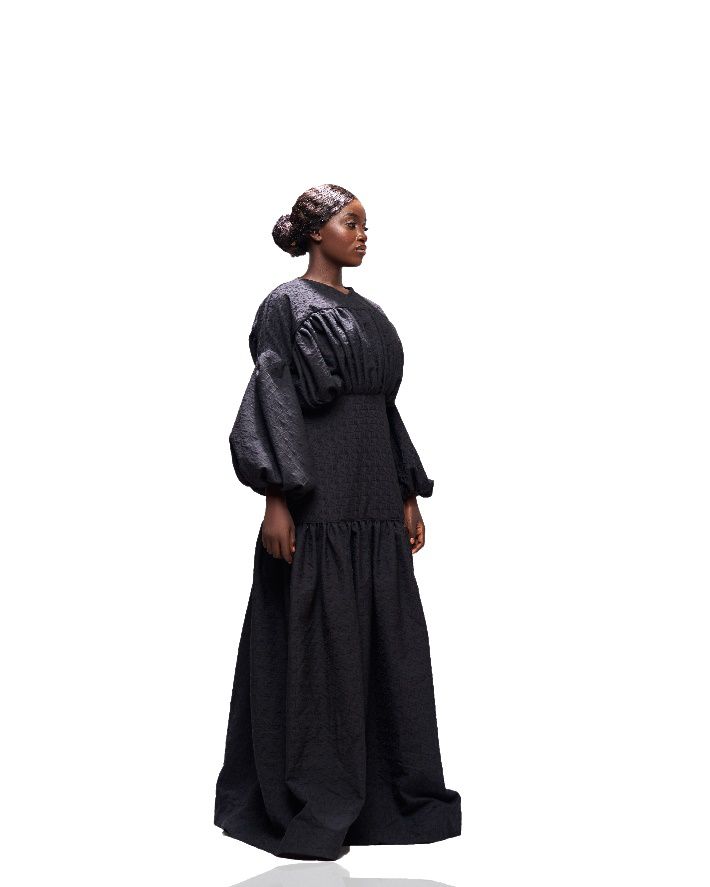
The first outfit in the Arivee 2025 collection is a floor-length, textured black maxi dress designed to define a new standard for effortless femininity. This piece features a gathered bust, an elongated smocked midsection, and dramatic puff sleeves. While the garment commands attention through its monochromatic depth, the structural choices fail to support the ambition of the design.
The pattern drafting logic fails by relying far too heavily on the smocked torso to provide the garment’s primary structure. The vertical seam tension along the sides is visibly strained where the heavy gathered skirt meets the elasticated waist. Because the fabric density is substantial, the puff sleeves possess impressive shape, yet this same weight creates a downward pull on the neckline. The internal interfacing is insufficient to support the sheer volume of the upper bodice, leading to a definitive failure in maintaining the intended silhouette.
The back view confirms these technical fails, particularly where the hidden zipper is forced against the smocked fabric. The seam tension is uneven, causing the zipper to bulge and ripple rather than lie flat against the spine; this directly contradicts the brand’s promise of “clean lines”. Furthermore, the lining structure is poorly executed, ending abruptly at the hips and causing the lower tier of the skirt to lose its architectural movement. Without proper internal support, the hem collapses inward, representing a failure in achieving the clean, circular sweep required for a luxury finish.
Reminiscent of the voluminous ease found in Cecilie Bahnsen’s collections but infused with a distinct Nigerian celebratory energy, Arivee’s positioning attempts to set a new tone for accessible luxury. While it shares the polished restraint of contemporary global boutiques, Arivee distinguishes itself by prioritising “wearable confidence” for diverse body types. However, for the brand to truly solidify its place in the evolution of inclusive African fashion, the technical execution must be as disciplined as the vision.
The second outfit in the Arivee 2025 collection is a floor-length, textured black maxi dress that attempts to balance voluminous drama with a fitted core. This piece features a gathered bust, an elasticated smocked midsection, and oversized puff sleeves. While the garment creates a strong visual impact through its monochromatic weight, the structural execution is a complete fail, as it does not support the ambition of the silhouette.
The pattern drafting logic represents a total fail by relying far too heavily on the smocking to provide the garment’s primary structure. I find that the vertical seam tension along the sides is visibly strained where the heavy, gathered lower tier meets the elasticated waist. Because the fabric density is substantial, the sleeves possess impressive shape, yet this same weight creates a downward pull on the neckline. The internal interfacing is clearly insufficient to support the sheer volume of the upper bodice, leading to a definitive fail in maintaining the intended crispness of the silhouette.
From behind, the technical failings are most apparent where the hidden zipper is forced against the smocked fabric. The seam tension is uneven, causing the zipper to bulge and ripple rather than lie flat against the spine; this is a direct fail against the brand’s promise of “clean lines”. Furthermore, the lining structure is poorly executed, ending abruptly at the hips and causing the lower tier to lose its architectural movement. Without proper internal support, the hem collapses inward, representing a failure in achieving the circular sweep required for a luxury finish.
Reminiscent of the voluminous ease found in Cecilie Bahnsen’s collections but infused with a distinct Nigerian energy, Arivee’s positioning attempts to set a new tone for accessible luxury. While it shares the polished restraint of contemporary global boutiques, the brand distinguishes itself by prioritising wearable confidence for diverse body types. However, for Arivee to truly solidify its place in the wider fashion landscape, the technical execution must be as disciplined as the design vision, as these structural fails undermine the overall quality of the piece.
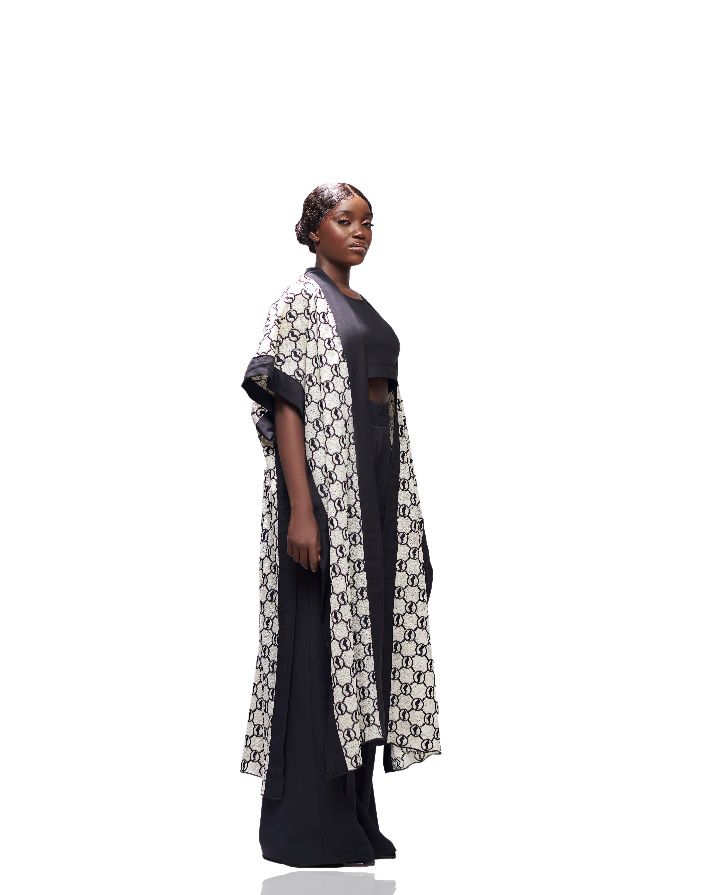
The third outfit in the Arivee 2025 collection is a monochromatic three-piece ensemble featuring a patterned floor-length kimono layered over a cropped bodice and wide-leg trousers. While the look successfully uses clean lines and a high-contrast palette to create a sense of movement, the technical construction reveals several significant fails. The pattern drafting logic for the kimono relies on an oversized drop-shoulder, but I find the execution fails because the seam tension along the armhole is inconsistent, leading to visible puckering where the patterned textile meets the solid border.
Furthermore, the fabric density of the outer layer is too light to maintain the architectural shape required for a luxury finish. The lack of internal interfacing in the front placket is a definitive fail; without this stiffening layer, the garment collapses forward rather than hanging with the precision expected of a high-end ready-to-wear piece. The cropped bodice also shows a failure in its lining structure, as the internal seams are visible through the light-coloured sections of the outer pattern, breaking the visual continuity of the set.
From the posterior view, the construction reveals another failure in the alignment of the patterned motifs. I observe that the pattern drafting logic did not account for pattern matching at the centre back seam, causing a jarring break in the geometric flow. Reminiscent of the relaxed luxury found in Rich Mnisi’s contemporary layers but adapted for the Nigerian event-goer, Arivee occupies a unique space between budget-friendly accessibility and high-fashion aspiration. However, for the brand to truly lead the wider fashion landscape, it must resolve these structural flaws to ensure the garment’s durability matches its visual appeal.
To conclude, Arivee occupies a distinct and necessary space within the Nigerian fashion market by offering high-fashion aesthetics at an accessible price point. However, this critique reveals that the brand’s technical execution currently fails to meet the high standards of its design vision. To transition from an emerging label to a dominant force in the wider fashion landscape, the brand must move beyond aesthetic appeal and prioritise rigorous structural integrity.
Addressing these fundamental flaws in seam tension, pattern drafting, and internal support will be essential for growth. While the brand successfully captures the vibrant energy of the modern woman, the physical construction of the garments must be as disciplined as the creative inspiration. Only by balancing its signature effortless femininity with expert craftsmanship can Arivee truly redefine modern elegance and solidify its artistic contribution to African couture.
About The Author